
A planted aquarium does more than look attractive. Live plants process ammonia and nitrate, compete with algae for nutrients, produce oxygen during daylight hours, and provide shelter that reduces stress in fish. Setting one up well requires understanding four interacting variables: substrate, lighting, CO2, and nutrients. Get the balance right and most plants grow without much intervention; get it wrong and algae blooms appear within weeks.
Substrate: the foundation plants grow in
Plain gravel holds plant roots in place but contains no nutrients. For low-maintenance plants like java fern, anubias, and mosses — which feed primarily from the water column rather than their roots — gravel works fine. For stem plants, carpeting plants, and sword plants with extensive root systems, a nutrient-rich substrate makes a significant difference.
Active substrates such as ADA Aqua Soil, Tropica Aquarium Soil, or Dennerle Scaper's Soil contain minerals and lower the water pH slightly over the first few weeks. This lowers KH and requires monitoring during the initial period, but suits South American plant species that thrive in soft, slightly acidic water. Lay active substrate 6–8 cm deep, with a slight slope towards the back for visual depth and root space.
Sand is an option for the foreground of a tank but should not be used as the primary substrate in a heavily planted setup — its fine particle size compresses over time, creating anaerobic pockets that produce hydrogen sulphide and rot plant roots.
Lighting: duration and intensity
Plants need light to photosynthesize, but more light is not always better. High light drives faster plant growth — which is fine if nutrients and CO2 keep pace — but excess light without sufficient CO2 or nutrients promotes algae. A common beginner mistake is running high-intensity lighting for 10–12 hours per day in a tank with no CO2 supplementation, then wondering why green spot algae covers every surface within three weeks.
Low-light setup (no CO2)
A lighting period of 6–8 hours per day at moderate intensity suits low-light species: anubias, java fern, java moss, vallisneria, and most Cryptocoryne varieties. LED fixtures designed for planted tanks and rated around 20–30 lm/litre are adequate. This is the lowest-maintenance approach and works well in tanks where fish welfare is the primary focus.
High-light setup (with CO2)
Demanding carpet plants like Eleocharis acicularis (dwarf hairgrass), Hemianthus callitrichoides (HC Cuba), or fast-growing stem plants such as Rotala rotundifolia require higher light intensity (40–60+ lm/litre) and supplemental CO2. Without CO2, these plants stall, then deteriorate, then trigger algae. Lighting duration in high-light setups is typically 7–9 hours with a midday break to reduce heat buildup and algae pressure.
CO2 injection
Carbon dioxide is the primary limiting nutrient for plant growth in most aquariums. Fish and bacterial respiration produce CO2, but usually not enough to support demanding plants under good lighting. Supplemental CO2 injection — via a pressurised cylinder, regulator, and diffuser — allows plants to grow at their natural rate and outcompete algae for nutrients.
Target CO2 concentration is typically 20–30 mg/L, measured using a drop checker with a reference solution. A yellow-green colour in the drop checker indicates approximately 30 mg/L. Running CO2 only during the lighting period (via a solenoid valve on a timer) conserves gas and prevents overnight CO2 buildup when fish are more vulnerable.
DIY CO2 systems using yeast and sugar in a bottle are an option for smaller tanks, but the gas output is inconsistent — rising in the first days of a batch and dropping off as yeast activity declines — which makes maintaining stable CO2 levels difficult.
If fish are gasping at the surface in the morning, CO2 concentration is likely too high overnight. Reduce the injection rate or improve surface agitation. CO2 and oxygen compete for the same water column space — excess CO2 forces oxygen out.
Fertilisation
Plants require macronutrients (nitrogen, phosphorus, potassium) and micronutrients (iron, manganese, boron, copper, and others). In a tank with fish, nitrogen and phosphorus are usually present in sufficient quantities from fish waste. Potassium and micronutrients — particularly iron — are consumed faster than they are produced and typically need supplementing.
Two approaches are common:
- All-in-one liquid fertilisers: Products like Tropica Premium Nutrition or Easy-Life ProFito contain a full range of nutrients in a single bottle. Dosing is simple and suits most community planted tanks.
- Estimative Index (EI) dosing: Separate macro (NPK) and micro doses are added several times a week at deliberately high concentrations, and 50% water changes weekly reset the parameters. EI aims to ensure nutrients are never limiting, relying on water changes rather than testing to manage buildup.
Beginner-friendly plant species
The following species are well-suited to tanks without CO2 injection and moderate lighting:
- Anubias barteri var. nana: Slow-growing, hardy, attaches to driftwood. Does not need substrate nutrients.
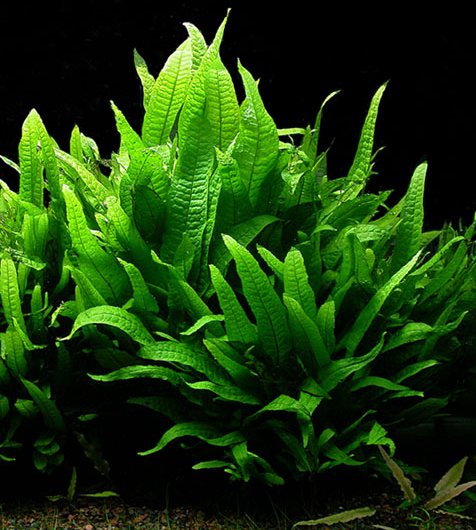
- Microsorum pteropus (Java fern): Similarly slow and undemanding. Propagates from rhizome divisions.
- Vallisneria spiralis: Tall background plant that spreads via runners. Tolerates hard, alkaline water well — suitable for tanks with cichlids.
- Cryptocoryne wendtii: Substrate-rooted rosette plant with minimal light requirements. Melts briefly when conditions change, then recovers.
- Vesicularia dubyana (Java moss): Attaches to any surface. Provides shelter for fry and shrimp. Tolerates a very wide range of conditions.

Algae and how to interpret it
Algae in a planted tank is almost always a symptom of imbalance rather than a cause. The most common patterns:
- Green spot algae (GSA): Round, hard green dots on glass and slow-growing plant leaves. Usually indicates low phosphate.
- Black beard algae (BBA): Dark tufts on plant edges and hardscape. Associated with inconsistent CO2 levels — typically appearing when CO2 fluctuates.
- Staghorn algae: Grey, branching threads. Common during tank cycling or after major disturbances to the nitrogen cycle.
- Green water (suspended algae): Turns the water cloudy green. Usually caused by excess light early in a tank's life before plants are established.
Addressing the underlying imbalance — adjusting nutrients, CO2 stability, or lighting duration — is more effective than trying to physically remove algae, which regrows quickly unless conditions change.
Sources and further reading
The Tropica plant guide provides detailed care notes for most commercially available aquarium plant species. For CO2 and fertiliser theory, the Barr Report contains technical discussions on Estimative Index and other dosing methods.